Web3 gaming shifts to sustainability as confidence returns: BGA

cointelegraphPublished on 2025-12-12Last updated on 2025-12-12

Abstract

The blockchain gaming sector is shifting toward sustainable economics and showing improved sentiment, according to the Blockchain Game Alliance (BGA). In its annual report, the BGA noted the industry is moving beyond speculative origins toward a product-led future. A survey of over 500 professionals revealed optimism rebounded to 65.8%, with a focus shifting from token economics to sustainable revenue models. Growth is now driven by high-quality games, resilient revenue models, and scalable payment infrastructure. The sector faced significant challenges, with annual funding dropping from $4 billion in 2021 to $293 million in 2025, leading to studio closures and a failure rate of 80-93% for Web3 games. However, factors like clearer U.S. regulations and the adoption of stablecoins are aiding recovery. Stablecoins enable fast, low-cost, borderless transactions without crypto volatility. Nearly 30% of respondents cited high-quality game launches as crucial for growth, with industry leaders emphasizing that real adoption is now taking hold.

The blockchain gaming sector is shifting to more sustainable economics and has improved sentiment and market maturity as it recalibrates its outlook, reported the Blockchain Game Alliance (BGA).

The Web3 gaming advocacy group said in its annual state of the industry report released on Wednesday that the sector is “moving beyond its speculative origins toward a more operationally disciplined, product-led future.”

In a survey of over 500 global blockchain gaming professionals, the level of optimism rebounded to 65.8% from its 2024 lows, with the focus shifting from token economics to sustainable revenue models.

“The clearest indicator of the industry’s broader transition lies in its reorientation toward sustainable economics.”

Growth is now anchored in delivering high-quality games, resilient revenue models, and payment infrastructure to support real-world commerce at scale, the report noted.
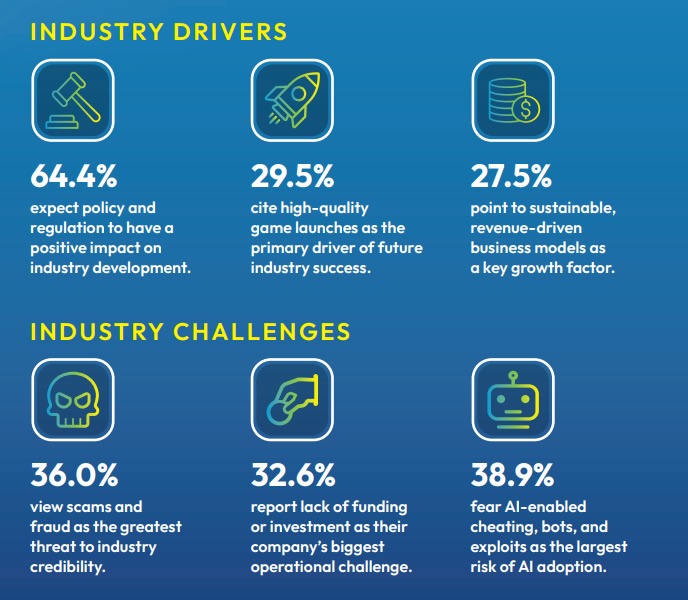
Clearer regulations are positive for the industry, said survey respondents. Source: BGA

A tough period for Web3 gaming

Blockchain and Web3 gaming have shifted from peak euphoria in 2021, driven by a play-to-earn explosion and speculative capital, to a low point in 2024, following the collapse of P2E models, a decline in confidence, and a drying up of funding, with studios closing and reputations being damaged.

Related: Investors target ‘fun-first’ crypto games as funding jumps 94% in July

Annual funding dropped dramatically to $293 million in 2025, down from $4 billion in 2021, forcing teams toward leaner, bootstrap-focused operations. Top-tier venture firms paused all new Web3 gaming investments, and project token prices collapsed more than 90% from cycle peaks.

Between 80% and 93% of Web3 games failed, with average lifespans of only months and studios that raised millions couldn’t sustain operations without continuous capital injections.

On the path to recovery

Several developments were cited as contributing factors to the recovery of the beleaguered sector, including regulatory shifts and the growing popularity of stablecoins.

Animoca Brands co-founder Yat Siu said recent crypto-friendly shifts in US regulations mean that companies no longer need to rely on setting up nonprofit foundations when planning token launches.

The BGA said that stablecoins were transformative for Web3 games, they gave gamers “fast, low-cost, borderless transactions without the volatility associated with other crypto assets.”

Additionally, nearly 30% of survey respondents cited high-quality game launches as the most important factor for industry growth.

Immutable’s vice president of global sales, Andrew Sorokovsky, said that “despite the negative headlines, blockchain gaming is now one of crypto’s most proven sectors — where quality projects are thriving and real adoption is taking hold.”

Magazine: XRP’s ‘now or never’ moment, Kalshi taps Solana: Hodler’s Digest

Related Reads

Oracle Plunges 40%, Will Excessive AI Infrastructure Overbuild Drag Down Giants?

Oracle's stock has plummeted 40% from its September peak, despite securing over $500 billion in AI infrastructure orders, signaling that massive backlogs alone no longer assure investor confidence. Similarly, Broadcom, with a $73 billion AI order backlog, and CoreWeave, which recently landed $36 billion in deals with OpenAI and Meta, have also faced stock declines. The market is growing skeptical of the AI infrastructure boom, concerned not only about suppliers' ability to fund and deliver these projects but also about the financial health and commitment of their major clients—primarily tech giants like Meta, Alphabet, Microsoft, Amazon, Apple, and Nvidia, alongside AI startups like OpenAI and Anthropic. While giants have robust finances, they are increasingly relying on debt to fuel AI capex, with soaring expenditures on data centers straining cash reserves and free cash flow. For instance, Microsoft, Alphabet, and Amazon are projected to collectively invest $1 trillion over four years. However, AI still contributes minimally to their overall revenue, raising questions about the sustainability of using profits from core businesses to fund speculative AI expansions. Execution challenges—such as power grid limitations, cooling issues, and community opposition—further complicate timely deployment. The critical uncertainty remains: if exponential AI demand fails to materialize and monetize quickly enough, these vast investments could lead to underutilized infrastructure, massive losses, and a fundamental weakening of these tech titans. The race between AI infrastructure build-out and actual market payoff will determine whether this bet becomes a triumph or a disastrous overreach.

marsbit48m ago

Oracle Plunges 40%, Will Excessive AI Infrastructure Overbuild Drag Down Giants?

marsbit48m ago

Trading

Spot
Futures
活动图片